The Sacrament of Baptism (Infants)

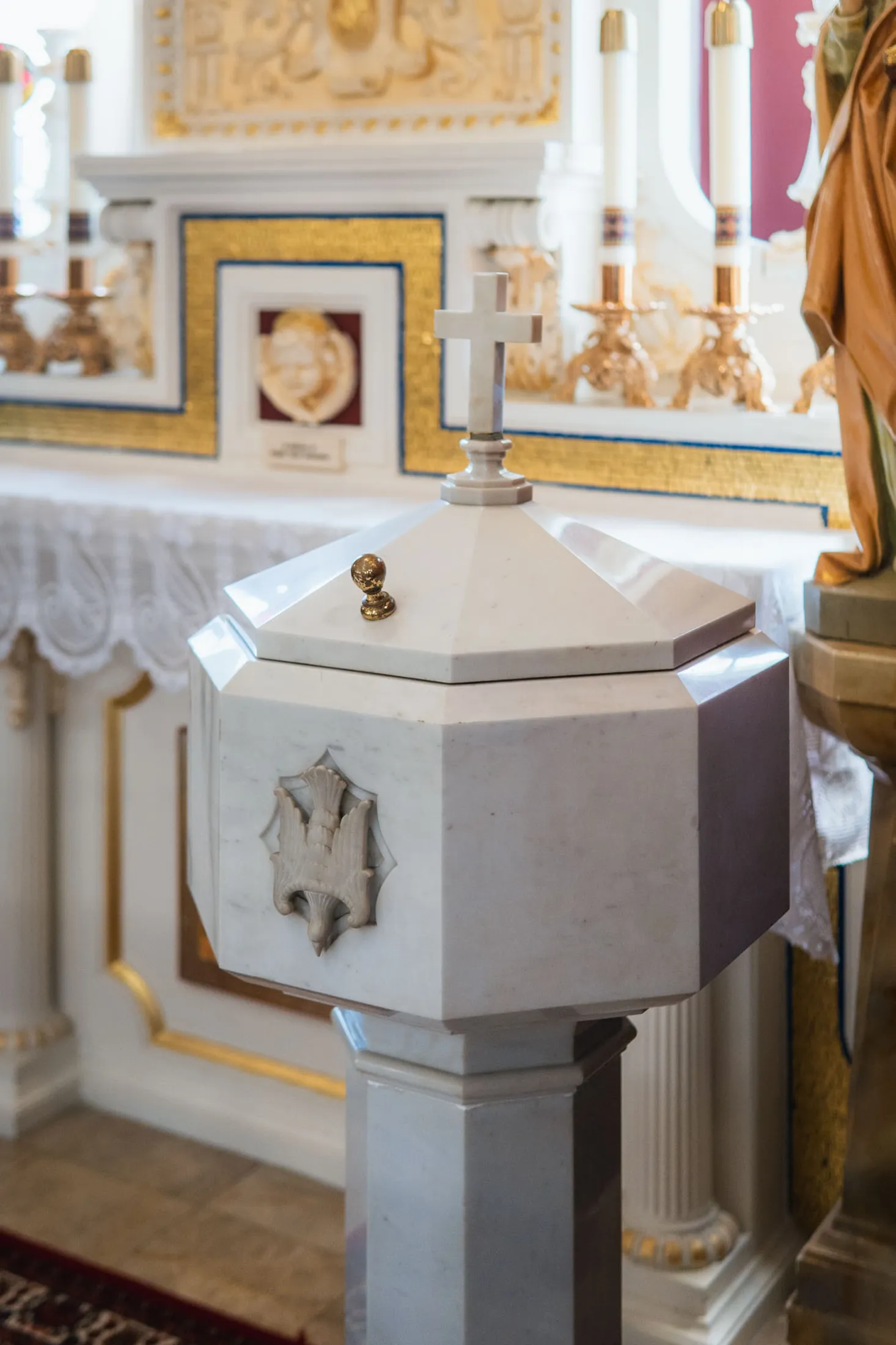
Holy Baptism is the basis of the whole Christian life, the gateway to life in the Spirit (vitae spiritualis ianua) (Council of Florence: DS 1314: vitae spiritualis ianua), and the door which gives access to the other Sacraments. (CCC #1213)
The word “baptism” means to “plunge” or “immerse.” This plunging does something beyond description. It actually brings about a complete transformation of the person baptized. They are “born again.” Remember what Jesus said to the Pharisee Nicodemus: “No one can enter the kingdom of God without being born of water and Spirit” (Jn 3:5). Baptism is that new birth. And this is not simply some symbolic or inspiring statement. Jesus is not just speaking in an analogous way. He’s telling the truth! Baptism is an actual new birth by water and the Holy Spirit. The result of this new birth is that a new person emerges. The old person enters into the water of baptism and dies. Then the new person rises from those waters. For this reason, the ideal form of baptism is full immersion. The person is completely plunged into the water just as Jesus died and entered into the tomb. And then, just as Jesus rose from the tomb, so also the newly created Christian rises from the waters.
Please fill out the form below and we will be in touch.
What are the requirements for Godparents and Sponsors?
When a child or an adult is to be baptized, he or she must have at least one godparent or sponsor (the terms are interchangeable). It is customary for children to have two godparents. When there are two, one must be male and the other female. Godparents must meet all of the following criteria, which are established by universal Church law and which do not vary from place to place. Godparents must:
(a) be Catholic
(b) have been baptized, confirmed and receive Communion
(c) be 16 or older (although there may be exceptions to this rule at the discretion of the bishop)
(d) must be living a life consistent with their own baptismal vows.
(e) if married, they must be married in the Catholic Church
This means that they must be practicing the faith, cannot be engaging in notorious sin, and cannot have taken public positions in opposition to Catholic faith or morals. The godparent/sponsor must obtain a letter or certificate from their own pastor which affirms that they meet the above requirements.
Godparent/Sponsor Form
Baptism is not a private act. It is a public, official liturgy of the Church and welcomes someone into the Catholic Church. Therefore, the Church has the duty and obligation to require reasonable criteria for being a sponsor. The sponsor is to assist the parents and the child in living a Catholic life. In order to do so, the sponsor needs to provide good example of living that life. A person who is not Catholic, or who is not living in a way consistent with the faith, obviously cannot provide the example that is part of the task of being a godparent. The role of godparent is a role of service done in the name of the Church, and the person who is a sponsor should be capable of performing that service.
First Holy Communion

In they came.
Little girls in pristine white dresses. Hair exquisite with flowing veils. White shoes spotless. Little boys in sports coats, ties, and dress pants. Hair trimmed to perfection. Faces shining from one last scrub. Two by two, they ambled down the central aisle with eyes glowing, palms pressed gently together and a final bow at the altar as they peeled off to sit with their beaming moms and dads, grandpas and grandmas, sisters and brothers. The feel in the sanctuary was holy, but electric.
These were our children. This is our Church’s future.
This is First Holy Communion.
But what does it mean?
Please fill out the form below and we will be in touch.
Confirmation

It must be explained to the faithful that the reception of the Sacrament of Confirmation is necessary for the completion of baptismal grace (Roman Ritual, Rite of Confirmation (OC), Introduction 1). For “by the Sacrament of Confirmation, [the baptized] are more perfectly bound to the Church and are enriched with a special strength of the Holy Spirit. Hence they are, as true witnesses of Christ, more strictly obliged to spread and defend the faith by word and deed” (LG 11; cf. OC, Introduction 2). (Catechism #1285)
So what is the Sacrament of Confirmation all about? Is it just a nice maturity ritual within the Catholic Church? Is it simply your own adult decision to be Catholic? Is it your graduation ceremony from religious education classes?!? No, it’s not any of these.
Please fill out the form below and we will be in touch.
3rd-6th Grade Ongoing Formation
Please fill out the form below and we will be in touch.
The Sacrament of Matrimony

“The matrimonial covenant, by which a man and a woman establish between themselves a partnership of the whole of life, is by its nature ordered toward the good of the spouses and the procreation and education of offspring; this covenant between baptized persons has been raised by Christ the Lord to the dignity of a Sacrament” ( CIC, can. 1055 § 1; cf. GS 48 § 1). (CCC #1601)
Marriage is intended to be the most stable institution in every society. For some, it is the most glorious and fulfilling relationship in their lives. Sadly, for others, marriage can leave deep wounds and hurt. This chapter will examine marriage from the design and perspective of God. Though Christian Marriage presents couples with a high ideal, like any gift from God, this ideal requires understanding, love and perseverance. Let’s begin with the original intent and design of God.
Couples who desire to be married at St Mary’s must be registered, active (attending Mass regularly on Sunday’s) and financially contributing to the needs of the parish.
Please fill out the form below and we will be in touch.
Funeral Mass of Christian Burial

Please accept our prayers and support for you at this time of loss in your life. We, at St. Mary of Perpetual Help Church, are here to help you through this time of sorrow and assist you in celebrating the Funeral Liturgy of the Catholic Church for your loved one. We are here to offer to you the beautiful and consoling Funeral Rite of Christian Burial of the Catholic Faith, rich in beauty and a wonderful source of strength at this difficult time, as it has been for over 2000 years to others who have experienced the death of a loved one.
The Resurrection of Jesus is the crowning truth of our faith in Christ, a faith believed and lived as the central truth by the first Christian community; handed on as fundamental by Tradition; established by the documents of the New Testament; and preached as an essential part of the Paschal mystery along with the cross. (CCC #638)
Without the Resurrection of Jesus, all hope is lost, and there is no meaning to His death. The Resurrection makes it possible for us to share in His new life and is then followed by Jesus ascending into Heaven and sending the Holy Spirit. Let’s look at some of the essential truths of the Resurrection so as to understand what it’s all about.
Please fill out the form below and we will be in touch.
If the body is to be cremated, the remains should be interned or buried immediately following the Funeral Mass. A Funeral Mass will only be offered if the remains of the deceased are to be buried immediately following the Funeral Liturgy. If the cremains of the deceased are to be buried outside of the state at a later date, please speak with Fr. Aschenbrener.
Click here for Instruction Ad resurgendum cum Christo regarding the burial of the deceased and the conservation of the ashes in the case of cremation.
STIPEND
Stipend for registered, active and contributing members of St. Mary’s: $900.00
Stipend for non-registered/non-contributing members of St. Mary’s: $1,100.00
Stipend includes:
• Church fee
• Music
• Deacon to assist at the cemetery
FUNERAL BOOKLET
Please have the family read through the Funeral Booklet (download here). If they have any questions, please have them speak to Fr. Aschenbrener. They must agree to the policies before seeking to schedule a funeral.
Sacraments for Adults

I am a non-baptized person who would like to become fully initiated into the Catholic Church. OCIA (Order of Christian Initiation of Adults) - click to read more
Today, infant baptism remains the common practice, but the OCIA process is a more developed practice with rituals (rites) along the way to make the stages of development on the journey to baptism. The journey really begins before an interested person ever steps into a church. Something inspires that person to come. It may be the prompting of the Holy Spirit to an open heart. It may be the faith they saw in another person. It may be because of an invitation from a Catholic friend to come to church. Something or someone has ignited a spark in the seeker. That leads them to inquire about becoming Catholic.
Once the initial contact is made by calling the parish office, speaking to the priest, deacon or OCIA Coordinator, they begin a period of inquiry where the person (called an inquirer or seeker) begins to learn the very basics of the Catholic Faith. After a short period of time, the inquirer undergoes what is called the Rite of Acceptance (for unbaptized) or Rite of Welcoming (for those baptized in another Christian denomination). Here they (with sponsors) attest to their interest in becoming Catholic and agree to continue. Then follows the Period of the Catechumenate. A catechumen is an unbaptized person learning more deeply about the Catholic faith. A candidate is a person baptized in another denomination preparing to be received into the Catholic Church. If the person chooses to continue, at the beginning of Lent they will undergo the Rites of Sending and Election when they become members of the Elect; those in final preparation for baptism or reception into the Church at the Easter Vigil. The period from the Rite of Election to the Easter Vigil is known as the Period of Enlightenment with final “studies”.
Those to be baptized, confirmed, and receive first Communion do so at the Easter Vigil. The Easter Vigil is the most Solemn Liturgy of the Year. The Easter Vigil recalls the history of God’s relationship with His people as told in the Old Testament and celebrates Jesus rising into new life. Therefore, it is appropriate that those who have been preparing themselves in OCIA receive Baptism at the Easter Vigil to enter into new life with Jesus.
